
By Joel Fischer, co-editor of the Yearbook of International Organizations and the International Congress Calendar
International meetings held by associations and organizations listed in the Yearbook of International Organizations indicate a trend in virtual and hybrid meeting use.
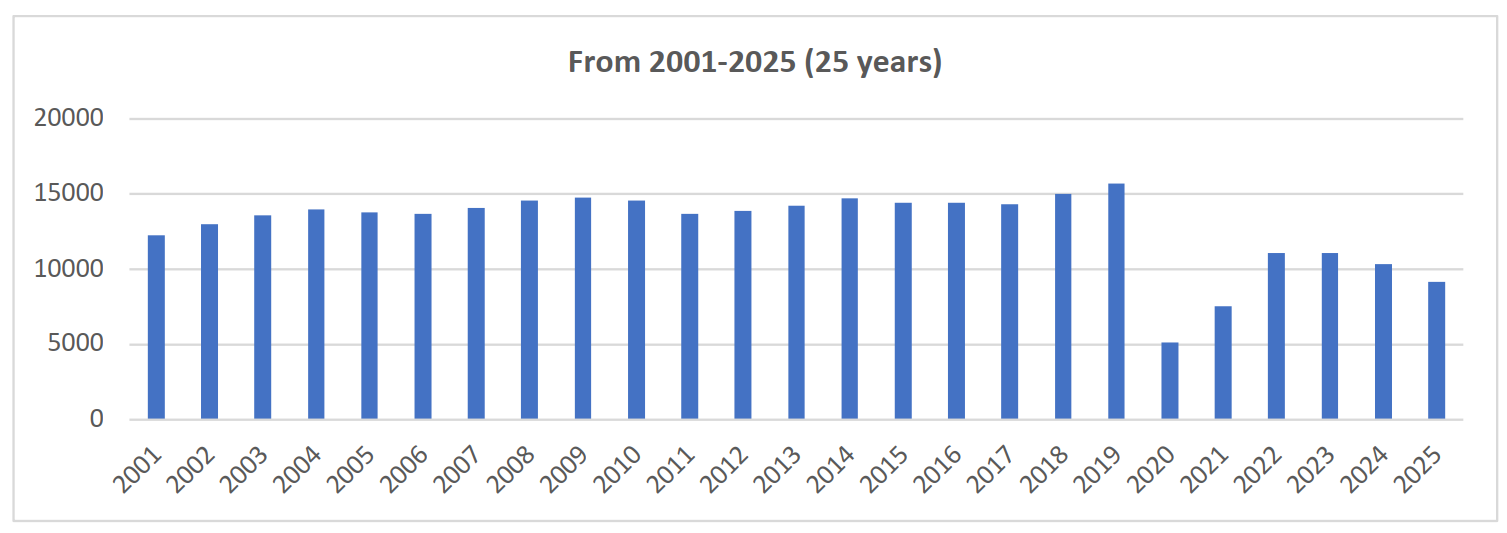
As is to be expected, data for 2020 and 2021 show that, in meetings where ‘online’ or ‘hybrid’ were specified, solely-online meetings were in the majority. For the period of 2023 through 2025 hybrid meetings are indicated at a level three times that of online-only events.
UIA’s data for these years will continue to increase in quantity, so we must wait to see how this trend develops. Many years of experience show that the number of meetings in the database for the year just past will, on average, increase by about 11% over the next year, by about 34% over the following five years, and by about 37% over the following seven years, as more events come to light. So additional time is required for the data to stabilize, with higher numbers, before we can more clearly describe the initial years of the pandemic and post-pandemic meetings activity. A clearer analysis of what took place in 2020, and the level of disruption, will be available next year.
The report on the year 2025 takes 556,638 meetings (across all years) into account, organized in 275 countries, in 12,908 cities, by 30,816 international organizations. For the year 2025, 9,321 meetings have already been included.
On average, between 900 and 1,200 new organization descriptions are added to the UIA database annually.
The Report covers meetings of international associations around the world and compiles data drawn from the UIA database, which is the source of the International Congress Calendar and the Yearbook of International Organizations. Since 1960 the UIA has published an annual Report of statistics on meetings held in the preceding year, based on routine research and on more specific surveys undertaken by the UIA. The term ‘meetings’ in this context includes events organized and/or sponsored by international organizations, such as congresses, regional sessions, regular sittings or assemblies. Continuity in the definitions used allows comparison over time and indications of trends.
Information in this wide-ranging Report includes the number of meetings per city and per country for the previous year, with the top 100 ranking cities and top 100 countries for that time, the top 30 rankings for cities and for countries over a twenty-year period, trends in meeting size and duration, and historical overviews, as well as a full listing of the places considered in the Report.
The annual Statistics Report is available in June, three months ahead of general release, to Associate Members as one of their many benefits: see Associate Membership.
Now the Report is available to all! For more information on the 67th edition of the International Meetings Statistics Report and to order your copy, go to: https://uia.org/publications/meetings-stats
Joel Fischer has been part of the UIA’s editorial and Secretariat staff since 1996.
Issue #25 – September 2026